

Author: cumbriahead
North West Education Summit
Clem Coady, Cumbria Branch President, reports on the first North West Education Summit, organised by NAHT…

Cumbria was well represented at the meeting held in Manchester, Friday 20th April, and attended by head teachers, parents, governors, politicians and wider school organisations such as the National Association of Small Schools. Everyone present attended to share their deep concern about the lack of funding in education and the drastic cuts schools are being forced to make, just to balance the books.
The event focused on the issue of school funding, and was not party-political, with MPs from across the north-west and political spectrum invited, although no Cumbrian MPs attended.
The event followed a meeting in September 2017 at Parliament at which I represented Cumbria. At that meeting we called for an inquiry to be opened by the Education Select Committee. This has now come to pass with key MPs directly involved and listening to representations including ours on behalf of Cumbria’s schools. At the North West Education Summit Lucy Powell MP, a member of the Education Select Committee spoke at length
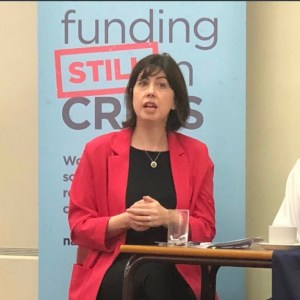
- Lucy Powell MP
and answered questions on policy decisions. She explained how she is challenging the government on education issues, highlighted the new inquiry that has been launched on school funding and called for as many schools as possible to respond in order to help champion our cause.
I was glad to add a Cumbrian voice to the many expressing their concerns, and to share some of the difficult and complex decisions school leaders are making across our county. We currently face a £10.9m cut to Cumbrian schools, with 234 out of 272 school facing real term cuts – averaging at £197 less funding per pupil. 2017 saw real cuts to Cumbrian schools with £27m cuts facing schools. Through adopting the New National Funding Formula, and the additional re-allocation of DfE funds of £1.3bn we believe our national campaign has eased the pressures we are facing here in Cumbria, although many schools across Cumbria continue to report severe funding difficulties, so there is more to be done.

Helen Jackman from the campaign group Penrith and Carlisle Parents Against School Cuts also gave a very passionate speech on how the cuts were impacting on children’s lives across our region, and the way that parents have played an essential role in lobbying for fair funding for all schools. “Eighteen months ago we’d never have imagined that we’d be doing something like this,” Helen said. “But we had started to notice cut backs and losses of staff in our local schools. We were very concerned, but felt completely powerless to do anything.
“Then, this time last year we received a joint letter from our local heads inviting all parents to a meeting with Rob Kelsall and Graham Frost of the NAHT. We heard head teachers like Clem Coady speak out in an unprecedented way about the impossible financial decisions they were having to make due to the cuts in school funding. They told us how they had trimmed as much as they could and that they were down to the bones.
“Finally we had the facts and could rise to the challenge.
“Within hours a parent group was created. We set up a Facebook page, met our MP, Rory Stewart and organised a protest. All within 10 days of hearing from the Heads. Over 500 people led by a Samba band, took to the streets of Penrith, our small market town. It was widely reported in the local news and even made Channel 4.”
Next steps
It would be great if all schools could respond to the Education Select Committee on the school funding issue.
As a professional association, we are continuing to gather the views of Cumbria’s school leaders. If your school is affected we would like to hear from you.
Clem Coady, Cumbria Branch President
NAHT CUMBRIA CONFERENCE
Empowering School Leaders – Present and Future
Wednesday 18th April – Stoneybeck Inn, Penrith CA11 8RP
- Examining the role of middle leadership in schools
- Evaluating practical strategies and techniques for developing your middle leaders
This conference is open to school leaders and aspirational school leaders, NAHT members and non-members.
 Caroline Bentley-Davies is the author of the best- selling book ‘How to be an Amazing
Middle Leader’ and the ‘Outstanding Lessons Pocketbook’. She has been a Local Authority Adviser, an Adviser, and she still teaches demonstration lessons to children in schools. She has
run training in primary and secondary schools across the UK and abroad.
Many Ofsted Inspection reports comment upon the need to develop Middle Leadership in schools, and Caroline’s session gives some practical suggestions for achieving this. She
will highlight strategies to help school leaders develop these skills with their subject co-ordinators and middle leaders and give a range of ideas to strengthen leadership in your school. For more information about Caroline see: www.bentley-davies.co.uk
 James Bowen is the national Director of NAHT Edge, the teaching union for middle leaders. James was previously the Headteacher of an outstanding Junior school in Hampshire. He has held a variety of leadership positions in schools including SENCo, subject leader and Deputy Head. He is passionate about developing leadership at all levels in schools, speaking and writing regularly on the topic.

Paul Whiteman is general secretary of the National Association of Head Teachers. NAHT is the largest union for school leaders in the UK, representing over 28,500 members in every phase of education.
09:00 Registration and Coffee
09:30 Developing Middle Leaders – Caroline Bentley-Davies
11:00 Coffee
11:15 Helping Middle Leaders to Thrive – James Bowen
12:15 Lunch
13:00 Matters of the Moment; NAHT advice – Paul Whiteman
14:00 Continuing Professional Development of Middle Leadership
14:30 Speed Networking (share resource/technique/book/website/idea which has had a positive impact on teaching and learning in your school). We will collate and email out all the ideas after the conference.
15:00 Q&A; Concluding Remarks
15:15 Finish
To book places to this event please do so through either: Cumbria SLA or Eventbrite
Please note that the number of places on this event are limited
Contact us for further information.
Government Officials Examining NAHT Cumbria’s Representation on School Funding
NAHT Cumbria Branch has received an initial response to our open letter from Elizabeth Truss MP stating that “officials are examining your ideas and suggestions” and that our “suggestions have been noted”.
As school leaders respond to a consultation about the implementation of the National Funding Formula in Cumbria, NAHT Cumbria have evaluated the documentation and have the following points to make:
- The majority of Cumbria’s schools are forecast to receive a modest increase to their basic, per-pupil income as a result of the NFF, therefore NAHT Cumbria Branch is broadly in favour of implementing it in 2018-19, however…
- There are schools which will receive a reduction in their basic, per-pupil income as a result of the NFF; NAHT Cumbria Branch are requesting that these schools contact us so that we can understand the implications for service provision.
- The NFF helps to address a historic underfunding of Cumbria’s schools, although it should be noted that it is to be implemented at a time at which the overall national funding allocation has not kept in step with rising costs for schools. While tight school budgets may be eased to an extent, calculations show that many will still have to consider making cutbacks in order to achieve a balanced budget.
- NAHT will continue to campaign for real-term funding cuts (all income and expenditure factored in) to be fully addressed to ensure that no school is adversely affected by changes to school funding or the cost rises schools already face.
- Pupil eligibility for deprivation-based funding is still a grey area, with final calculations of eligibility likely to dramatically affect the final income figures calculated for schools, either positively or negatively. NAHT is campaigning for automatic registration of pupils for FSM/EVER6 as the information to calculate entitlement is already accessible to civil servants.
Commenting on the latest developments, Clem Coady, NAHT Cumbria Branch President stated:
“The NAHT have repeatedly stated our support for a fairer redistribution of funding. However, the National Funding Formula is being implemented at a time when schools are facing severe financial pressures. The National Audit Office already recognise that £3 bn is needed by 2019-20 to maintain current levels of education. Therefore £1.3 bn, while a welcome improvement on previous announcements, still falls significantly short of this figure.
“The Public Accounts Committee further warn ministers that education funding is currently at a similar rate as the 1990’s. When you compare funding spent on education as a % of GDP, we are currently spending less on education than the government of the early 1980s.”
“The additional income being quoted for some schools locally is a welcome redistribution, particularly since historically, Cumbria has been comparatively underfunded. Any additional income will go some way to addressing the numerous increased cost pressures on schools. However, when all the costs are factored in, this will still not be enough for many of Cumbria’s schools, with several already having to consider making drastic cuts to staffing and services to balance the books.
Graham Frost, NAHT Cumbria Branch Secretary commented:
“Politicians have a tendency to be selective in their quoting of figures. To quote a single line on a spreadsheet is misleading, and does not take account of the overall effects of reductions in other services outside the school budget, such as school nursing and specialist support for inclusion, all of which require schools to pick up substantial, additional costs to replace them. Nor does it take account of variable costs such as building maintenance, transport, or the increases to basic running costs which schools are powerless to avoid.
“We have written an open letter to the Chancellor of the Exchequer expressing our concerns about school funding and have received a reply from Elizabeth Truss MP, stating that “officials are examining your ideas and suggestions” and that our “suggestions have been noted”. We also have meetings scheduled with local MPs, including Tim Farron, Trudy Harrison and Rory Stewart, all of whom are seeking to understand the specifics of the challenges facing our schools.”
Over 70 Cumbrian school leaders call on Philip Hammond to end school funding crisis
News and Star – Backlash-from-headteachers-over-schools-funding-should-be-wake-up-call-to-Government
All across the country, people from all walks of life, who recognise the value of a good education, are waking up to the stark reality schools are squaring up to. We simply must invest in education now – our children are depending on us to get this right. We hope that the Chancellor of the Exchequer will take our letter (below) very seriously and consider it his ambition and moral duty to fund schools fully and fairly, taking all the costs into consideration. By providing a clear overview of the particular challenges the current level of underfunding presents to Cumbria’s schools, we also want to help our politicians to champion the cause of Cumbria’s children in Westminster.
Saturday, 14 October 2017
Rt Hon Philip Hammond MP
Chancellor of the Exchequer
HM Treasury,
1 Horse Guards Road,
London,
SW1A 2HQ
Dear Mr Hammond,
Education is an investment – the greatest investment we can make in our children’s present and future lives. We have heard many figures quoted over the past few months, from long before the snap election was called, during the election campaign and since. We applaud the reallocation of £1.3 billion from spending on free schools to the main schools budget, which was an acknowledgement that spending on schools needed to be increased. However, the latest figures indicate that the financial pressures schools in Cumbria are already experiencing are set to continue, with an estimated total shortfall of £13.3 million by 2020, equivalent to a £226 per pupil loss or the salaries of 272 teachers.
We can already see the effects of the combination of cuts to other local services, resulting in our schools having to pay for services previously funded from other budget streams, and increased payroll related costs such as the increased pensions contributions required of schools. We can already see the effects of the lack of investment in school building maintenance, the leaking roofs and other long-overdue repairs to buildings presenting health and safety concerns. We can already see the effects of resources such as computers coming to the end of their useful working lives and not being replaced. Some schools are already engaging in redundancy processes signalling a reduction in provision for special educational needs and disabilities, or a reduction in the number of subjects they have the capacity to teach.
In Cumbria we are very proud of the high reputation we have for inclusive practice, with the vast majority of special educational needs and disabilities being met within mainstream school settings, unlike many other parts of the country in which these needs are met by a concentration of expertise within a greater number of special schools. Being “Inclusive Cumbria” means that the expertise to meet these needs is spread across the school system, and predominantly consists of highly trained and skilled teaching assistants. Between 80% and 90% of a schools’ budget is staffing costs, and Cumbrian schools are reporting that in order to set a balanced budget they are already having to make staff reductions or plan for them within the next few years. We fear that some of our most vulnerable pupils will be hardest hit by the funding pressures our schools are being forced to tackle.
While we commend the intention to redistribute funding more fairly through the National Funding Formula, we believe it will only succeed if there is sufficient funding within the overall schools budget. Cumbrian schools serve many rural or isolated communities. The current shortfall in school funding is causing tensions between our financially challenged large secondary and primary schools, and the small rural schools which are the life-blood of local community life. Simply considering school viability on a one-size-fits-all calculation does not work in a county with our landscape, and the wider implications of our geography need to be factored in to any future calculations of school funding distribution at a national level.
Many are predicting that a significant proportion of future employment opportunities in Cumbria will come from science and technology based industries such as the nuclear power industry. The government’s industrial strategy, January 2017 (https://www.gov.uk/government/uploads/system/uploads/attachment_data/file/611705/building-our-industrial-strategy-green-paper.pdf) states the following as a central pillar:
Developing skills – we must help people and businesses to thrive by: ensuring everyone has the basic skills needed in a modern economy; building a new system of technical education to benefit the half of young people who do not go to university; boosting STEM (science, technology, engineering and maths) skills, digital skills and numeracy; and by raising skill levels in lagging areas.
An underinvestment in education at this time stands to undermine this worthy objective which is crucial to future employment prospects for a great many of our pupils.
As school leaders, we are already doing all we can to be good stewards of the funding allocated to our schools, but we are now reaching a point which is untenable, and parents are beginning to notice. We therefore call upon you, as Chancellor of the Exchequer, to ensure that school funding, in real-terms, with all the increased costs factored in, enables our schools to at least maintain the quality of service provision needed to ensure our pupils can become fulfilled, successful and economically secure, both now and in their future working lives.
Sincerely,
Andrea Armstrong, Headteacher, Raughton Head CofE School
Mark Ashton, Headteacher, Warwick Bridge School
Sue Blair, Headteacher, Pennine Way Primary School
Kenneth Boom, Chair of Governors, Pennine Way Primary School
Mick Brookes, Cumbria Branch Treasurer, NAHT
Clair Brown, School Business Manager, St James C of E Infant School
Jonathan Bursnall, Headteacher, Brook Street Primary School
Jan Cameron – Governor, Brook Street School
Sarah Campbell, Headteacher, Settlebeck School
Andrew Cannon, Headteacher, Newlaithes Junior School
Lynn Carini, Headteacher, Holme St Cuthbert School
Toby Clements, Chair of Governors, Stoneraise School
Clem Coady, Cumbria Branch President, NAHT
Maggie Cole, Headteacher, St Thomas’s CE Primary School
Dave Colombi, Headteacher, Thursby Primary SchoolHuw Davies, Headteacher, Ghyllside Primary School
Martin Duke, Chair of Governors, North Lakes School
Suzanne Edmondson, Headteacher, St Patrick’s CofE School
Nick Ellery, Headteacher, Ullswater Community College
Julia Fish, Headteacher, Bridekirk Dovenby School
Samantha Fitzsimons – Governor, Brook Street School
Linda Fletcher, Headteacher, Crosscrake CE Primary School
Graham Frost, Cumbria Branch Secretary, NAHT
Sue Frost, Headteacher, Ashfield Junior School
Brenda Fyrth, Headteacher, Thomlinson Junior School
Johanna Goode, Headteacher, Grasmere CE VA Primary School
Judith Gore, Headteacher, St Martin and St Mary’s CofE Primary School
Alister Green, Chair of Governors, Ivegill CE Primary School
Georgina Harland, Headteacher, Bewcastle Primary School
Geraldine Haughan, Head of Administration & Governor, Brook Street School
Lisa Hemingway, Headteacher, St Bridget’s CE Primary School
Peter Hicks, Headteacher, Heron Hill Primary School
Matthew Jessop, Assistant Headteacher, Low Furness CofE Primary School
Alan Johnston, Chair of Governors, Robert Ferguson Primary School
Gareth Jones, Headteacher, Cummersdale School
Chris Kania, Senior Office Administrator, Pennine Way Primary School
Catherine Mallard, Headteacher, St Begh’s Catholic Junior School
Nancy McKinnell, Headteacher, South Walney Infant and Nursery School
Louise McMillan, Headteacher, St Bede’s RC Primary School
Kath Mitchell, Headteacher, Cumwhinton Primary School
Angela Nellis, Office Manager, North Lakes School
Gary Newman, Headteacher, Skelton School
Fiona Newton, Headteacher, Askam Village School
Geoff Norman, Headteacher, Wigton Infant School
Mike Pincombe, Headteacher, North Lakes School
Emma Pomfret, Headteacher, Orton CE Primary School
Duncan Priestley, Headteacher, Crosby Ravensworth CE Primary School
Teresa Readman, Headteacher, St Joseph’s Catholic Primary School
David Reddy, Headteacher, George Romney Junior School
Claire Render, Headteacher, Wreay C of E Primary School
Helen Richardson, Headteacher, Castle Park School
Chris Rollings, Deputy Head, North Lakes School
Sharon Sanderson, Headteacher, Brunswick Infant School
Sonia Southern, Headteacher, Burgh by Sands School
Daryl Spencer, Headteacher, Fir Ends School
Rebecca Stacey, Headteacher, Castle Carrock School
Sue Stainton, Headteacher, Ivegill CE Primary School
Cathy Styles, Headteacher, Croftlands Junior School
Phillipa Summers, Headteacher, Grange CofE Primary School
Sarah Tansey, Headteacher, Dean Gibson Catholic Primary School
Margaret Taylor, Headteacher, High Hesket Primary School
Matthew Towe, Headteacher, Sedbergh Primary School
Lynne Wade, Headteacher, Kirkby Stephen Primary School
David Warbrick, Headteacher, Beckstone Primary School
Dawn Watson, Headteacher, Eaglesfield Paddle CE Primary School
Helen Webber, Headteacher, Black Combe Junior School
Ruth Webster, Headteacher, St Paul’s CE Junior School
Ayesha Weston, Headteacher, Crosby-on-Eden CofE School
Patricia Williams, Chair of Governors, St Joseph’s Catholic Primary School
Kirsty Williamson Headteacher, Great Corby School
Deborah Wilson, Headteacher, Millom Infant School
Lesley Winter, Headteacher, Gilsland C E Primary School
c.c. Tim Farron MP, Trudy Harrison MP, Sue Hayman MP, John Stevenson MP, Rory Stewart MP, John Woodcock MP.
Election Candidates Invited to Support NAHT’s #5Priorities
Election candidates who have expressed their intention to support NAHT’s #5priorities in the next parliament:








NAHT are inviting all prospective MPs to express support for NAHT’s 5 priorities in the next parliament:
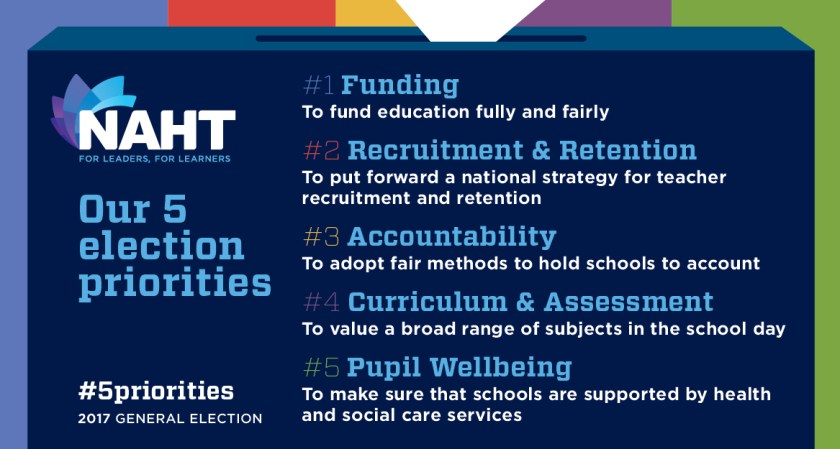
Read about our 5 priorities in greater detail.
See Cumberland News report on this campaign.
NAHT Cumbria are also offering to brief any prospective MP of a Cumbrian constituency on any of the priorities, particularly funding. As and when any of them sign our pledge to support our 5 priorities, we will post their photos here (alphabetical by surname). The best way to contact us is via Twitter – follow @NAHTCumbria (see the panel on the right).
Prospective MPs can download the pledge form and send us a photo of themselves signing it: NAHT 5 Priorities Pledge
Find us on Twitter – @NAHTCumbria
Email – graham @ nahtcumbria . org . uk

Parents Organise Rallies Following Public Meetings
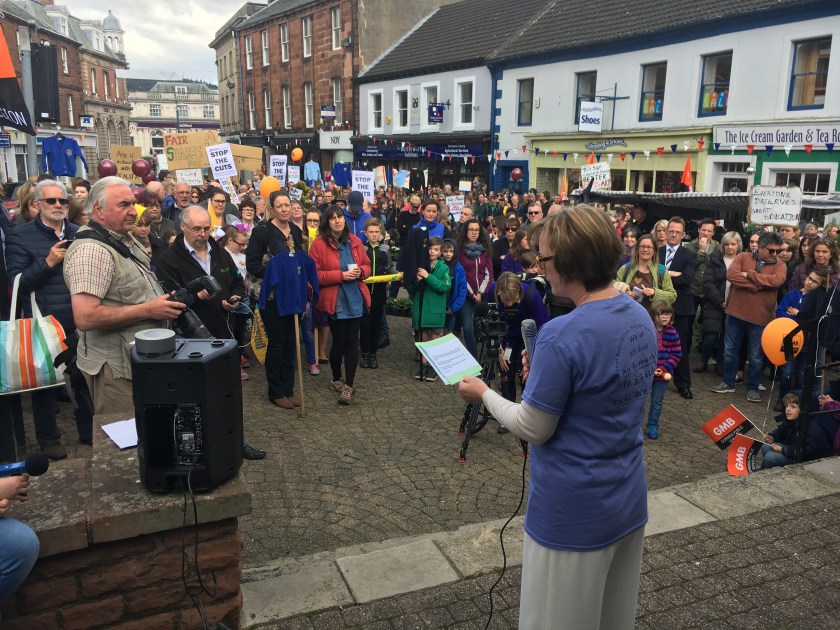

Graham Frost, Cumbria Branch Secretary

The Penrith Crowd

Nigel Pattinson, Headteacher

Parents and Children march into Penrith
Parents’ Groups Organise Rallies
Following the NAHT-led public meeting in Penrith, a group of parents were motivated to set up a campaign group – Fair Funding for Cumbrian Schools and organised a rally, which took place at the Cornmarket, Penrith on Saturday 6th May. See coverage by News and Star, Cumberland and Westmorland Herald, and ITV Border. Parents in Carlisle who had attended our Carlisle public meeting held a second rally on Sunday 21st May, in Carlisle. See coverage by ITV Border and News and Star.

- NAHT Cumbria’s Clem Coady speaks at parent-led rally – Carlisle City Centre – 21st May 2017
Parents Express Shock at the Funding Crisis
Over 250 members of the public, including parents, grandparents, school staff and governors and union representatives, have attended our three public meetings about the School Funding Crisis:
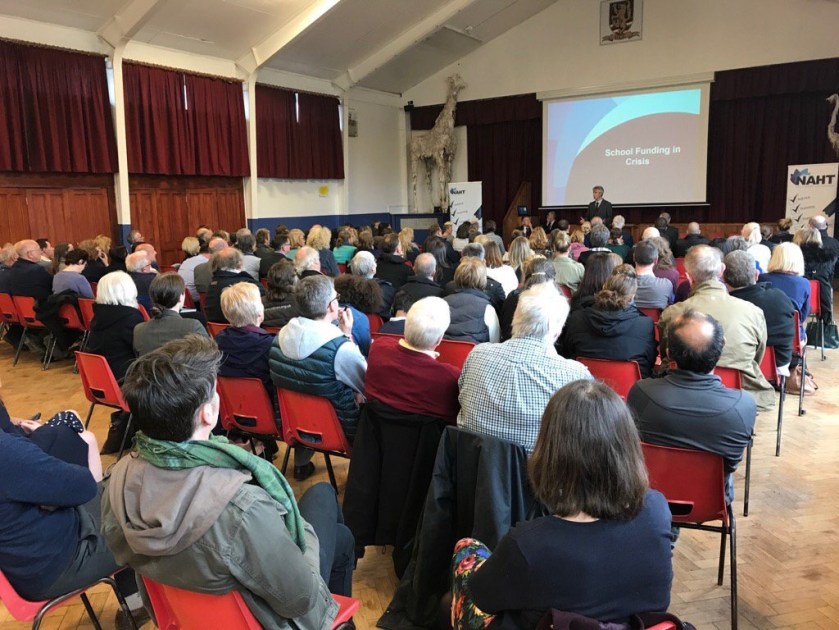
Tuesday 25th April – 6:45pm – Caldew School, Dalston, nr Carlisle.
Wednesday 26th April – 6:00pm – Ullswater Community College, Penrith.
Thursday 4th May – 6:30pm – West Lakes Academy, Egremont.
Local MPs were also invited, but did not attend.
Rob Kelsall, Senior Regional Officer (NAHT) presented the facts and figures, spelling out that the crisis results from a combination of factors. Citing figures from the National Audit Office (NAO), and Institute for Fiscal Studies (IFS), Rob explained that the benefits to Cumbria of the redistribution of funds through the National Funding Formula, something which NAHT have been calling for for many years, are effectively wiped out by two other factors:
- £3 billion in cuts to overall spending on schools, as reported by the NAO.
- An estimated 8% increase in costs to schools (NAO).
In more detail, the cause of the problem is:
- Increases in the cost of employer’s contributions to national insurance and pensions of over 5.5%.
- The abolition of the Education Services Grant to local authorities and academies reduces funding for schools by £600 million.
- The cost of annual pay awards for teaching and support staff is set to increase by 4.4% by 2020.
- The Apprenticeship Levy came into effect in April 2017.
- The National Audit Office estimates that these additional cost pressures adds up to an 8% increase in the cost of running the average school.
Funding from government is remaining static over the same period, resulting in a real terms cut.
Cumbria NAHT branch secretary, Graham Frost explained that Cumbria’s schools are already feeling the increased financial pressure, with some already having to cut staff and curriculum breadth. See How Real Term Funding Cuts are Affecting Cumbria’s Schools. At the Penrith meeting, he gave a personal response as a parent whose children attend Ullswater Community College (UCC), where the meeting was held:
“My older daughters have received a truly excellent education at UCC, with an impressive range of subjects to choose from, including vocational courses. I despair at the thought that my youngest daughter will not have the same opportunities due to no fault of the school, but due to a combination of drastic cuts and cost pressures.”
Ullswater Community College headteacher, Nigel Pattinson, gave a passionate speech outlining how the school’s budget has changed in recent years, which has gone from £8.05m in 2009, when he joined Ullswater, to £6.89m. He described the terrible choices schools face, including the scrapping of whole subjects, axing jobs and bigger class sizes, saying:
See the video and read Clem Coady’s explanation of the crisis.
Cumbrian Heads Engage in National Debate at Conference
Amid the biggest crisis facing the nations schools in decades, Cumbria’s NAHT officials have been campaigning harder than ever and making a major contribution to debates at the 2017 National Conference in Telford.
School Funding
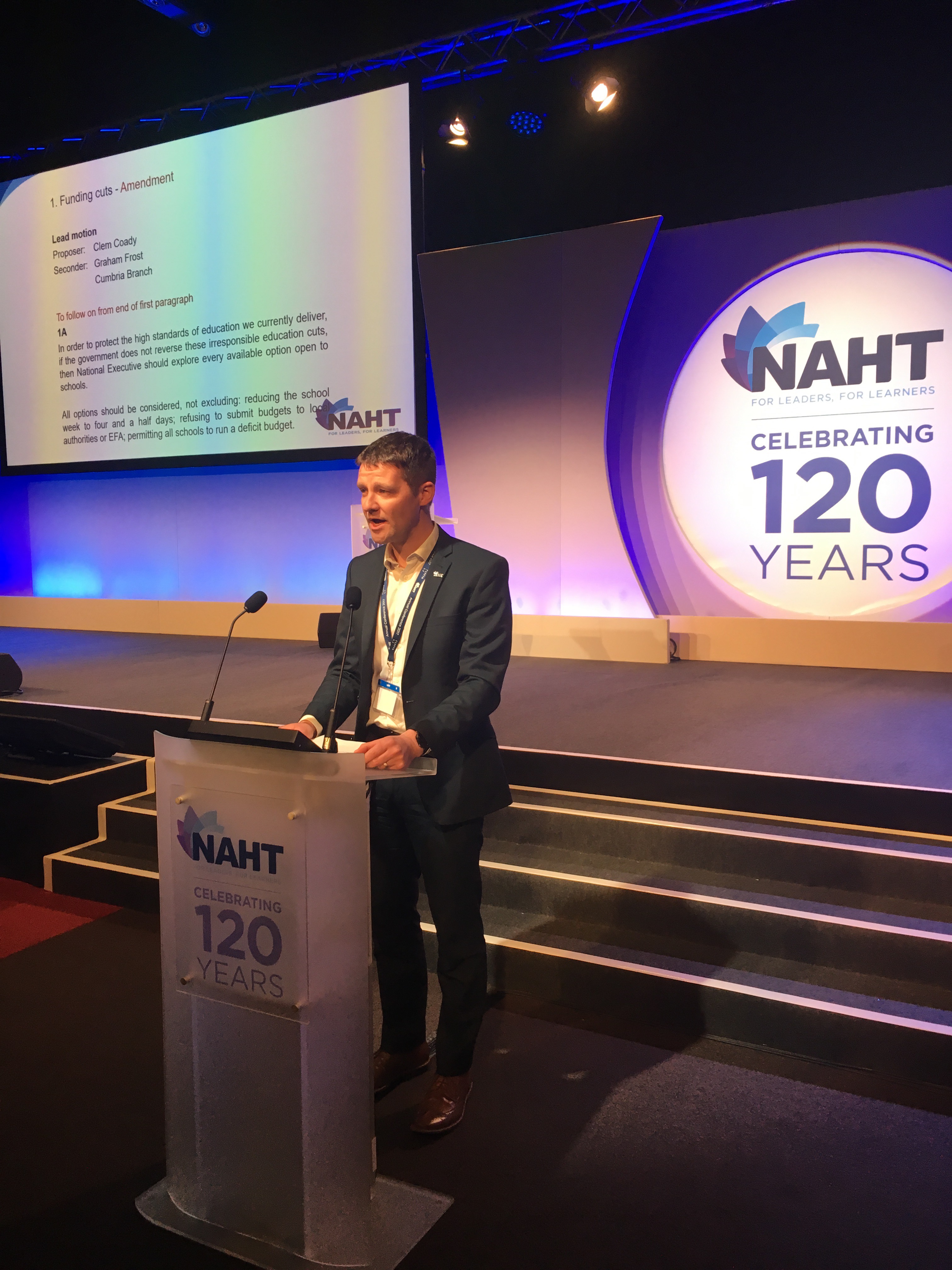 On Saturday 29th April, Clem Coady (Executive Member) proposed an amendment to the lead motion on school funding, seconded by Graham Frost (Branch Secretary), calling for all options to be on the table when National Executive consider the best action to take in response to the drastic £3 billion under funding of schools, as reported by the IFS and NAO, two government departments.
The previous day, an open letter to which both Clem and Graham, and several other Cumbrian headteachers were signatories, outlined NAHT dismay at the continuing denial of the funding crisis by the government.
Meeting Labour Party Leader, Jeremy Corbyn
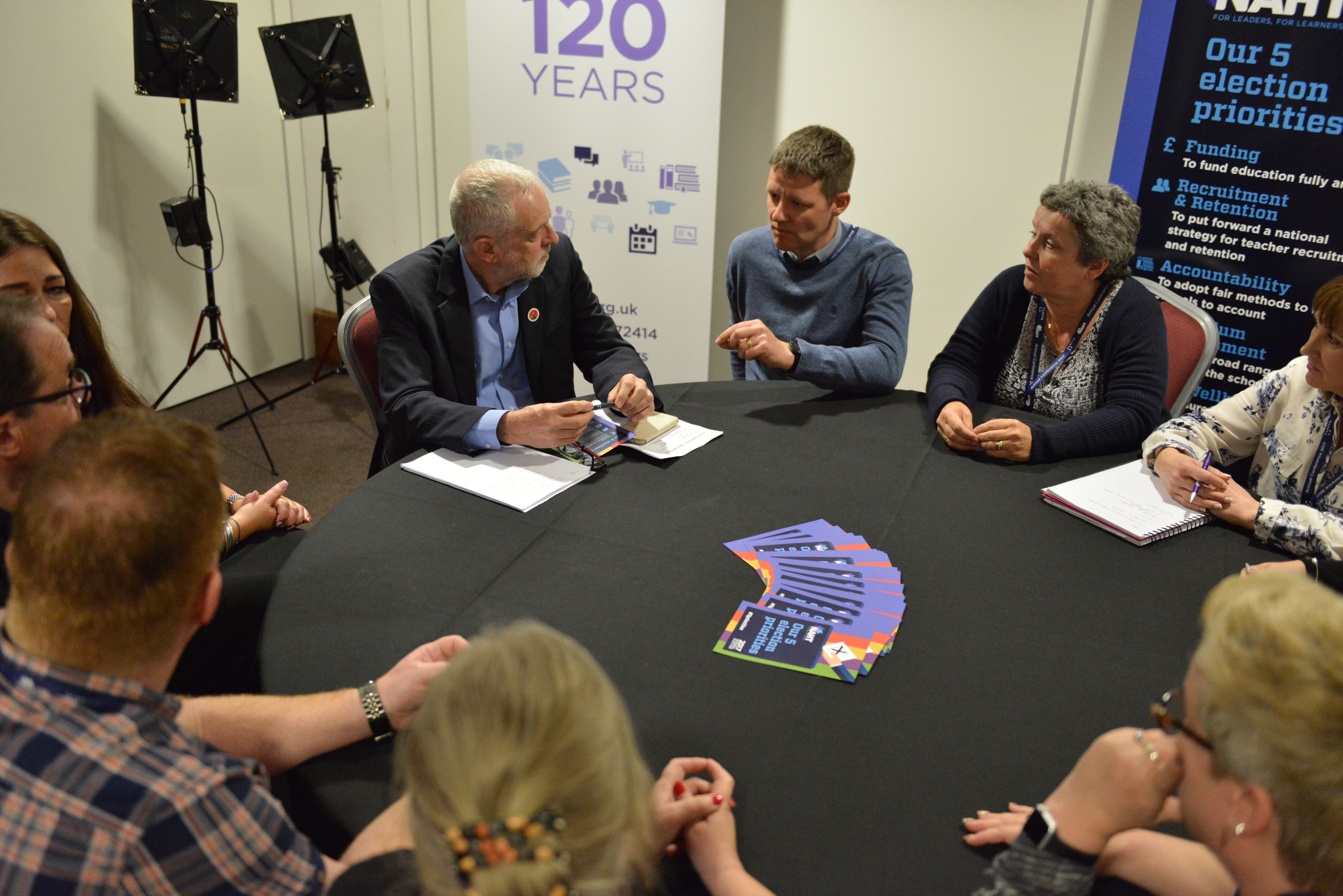 On the Sunday, Clem also had the privilege of questioning Labour Party Leader, Jeremy Corbyn following his address to conference.
“The meeting gave me the chance to really hammer home what the situation is for Cumbria’s headteachers and what we would like to see happen,” said Mr Coady.
“It wasn’t easy for him. We really challenged him on everything. It wasn’t a meeting he was prepared for. He didn’t know what we were going to say. We were asking how he was going to deliver on some of his pledges.
“It allowed me to get across the message on funding for Cumbrian schools.
“It was a key discussion which was very much about funding and then we also discussed things like the way schools are having to pay for school nurses and other services now.
“They are services which are an NHS responsibility, as is child mental health, and we’re picking up the tab.”
Conference had hoped to hear from Secretary of State for Education, Justine Greening MP, but she had withdrawn from speaking to delegates on the Saturday.
Assessment and Accountability
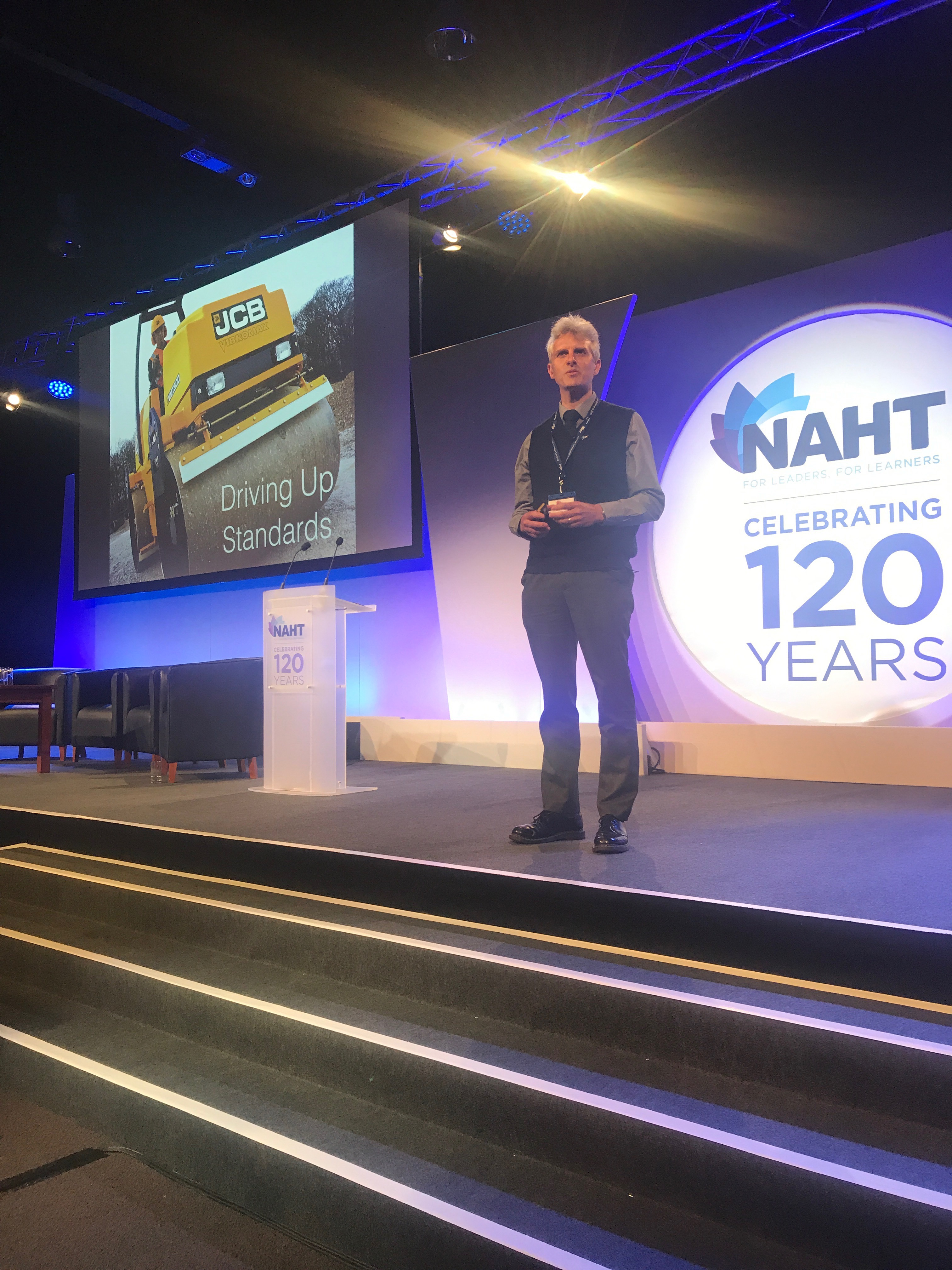 High-stakes accountability and over-reliance on data was another motion which received a very positive response. Graham Frost outlined the need to expose and discredit the statistical and politically-motivated manipulation of test and grade boundaries and to raise professional and public awareness of the harmful and unjust implications for both students and professionals in all phases of education.
Governance
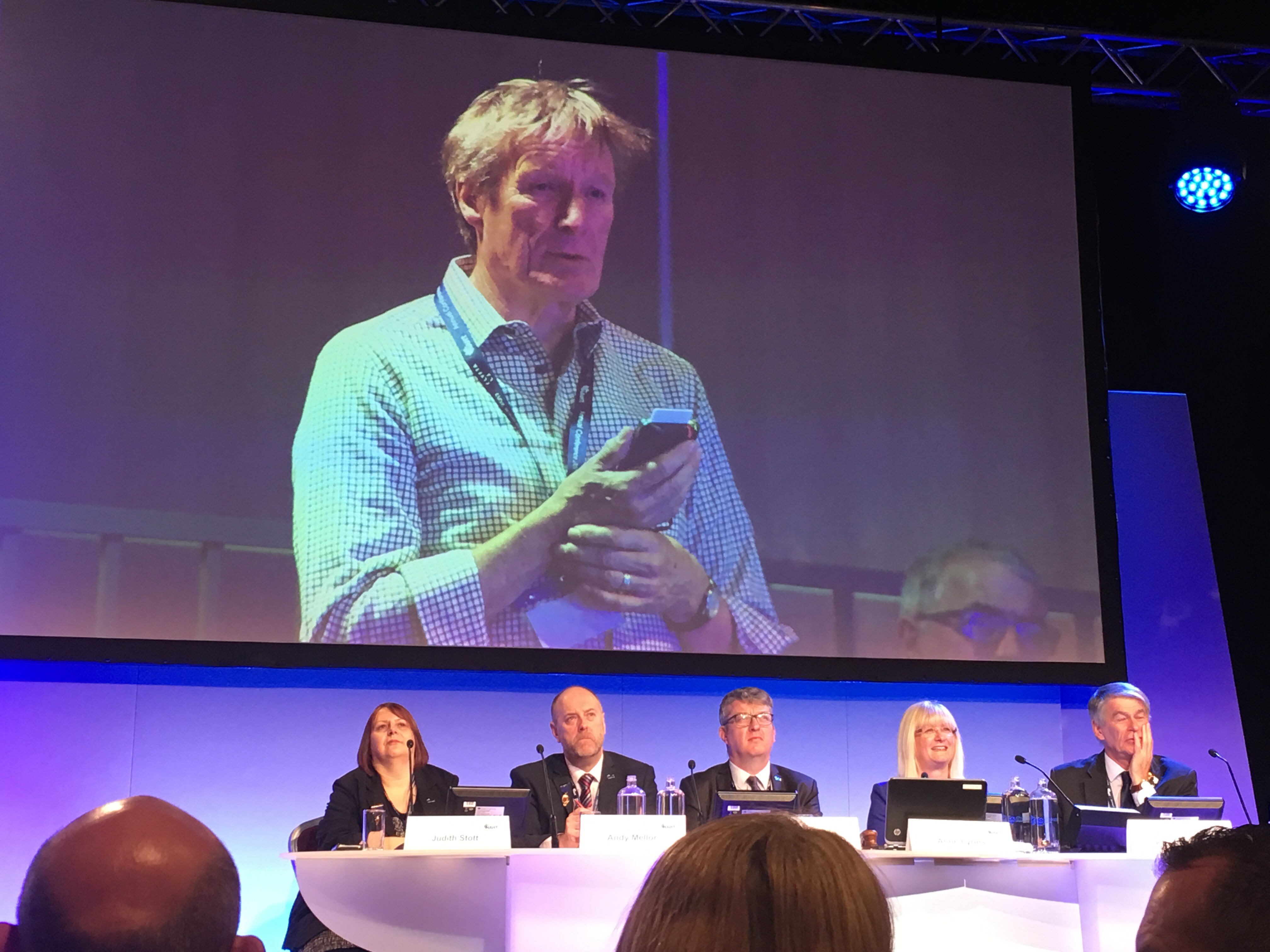 Maggie Cole (Branch President) was accompanied to the conference by Mick Brookes (Treasurer and General Secretary prior to Russell Hobby) and Tim Glendinning (National Executive Member), all of whom made valuable contributions at the 2 minute microphones, during the conference motion debates. Mick supported a motion which called for a reduced emphasis on governance within the judgement for leadership in Ofsted and reduction in the expectations, workload and ever-increasing accountability of the volunteers who put themselves forward as governors. Mick, who is a chair of governors himself and provides support to governors and governor training in Cumbria, made the point that school leaders careers are being put on the line by “bewildered” governors.
Meeting the Chief Ofsted Inspector
Clem and Graham were among the many delegates who had the opportunity to meet informally and chat with Amanda Spielman, the recently appointed Chief Ofsted Inspector.
“It was very encouraging to listen to Amanda Spielman talking so warmly about the profession we love, and someone who clearly knows that school leaders welcome and encourage school accountability when it is conducted in a positive and constructive manner,” said Graham.
“During the conversation, I told her how I had both positive and negative experiences of inspection, one of which I described as a welcome ‘health check’ for my school, and another about which I had to complain because of the manner in which it was conducted.
“She was genuinely interested in what we had to say, and gave the impression that she is determined to make significant and welcome improvements to her organisation. We were very impressed.”
Listen to the NAHT exclusive interview with Amanda Spielman.
Russell’s Farewell Conference Speech
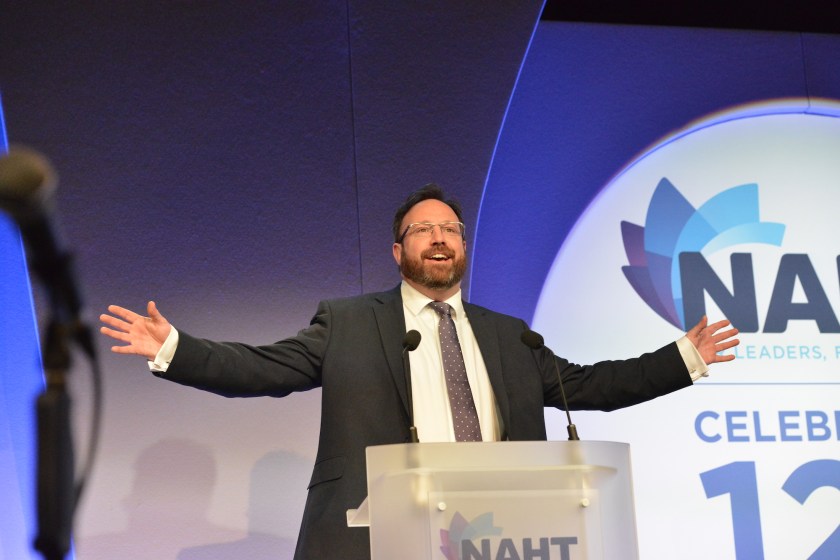 It was an emotional farewell speech from Russell who stands down after seven years leading the NAHT. As usual, Russell’s speech struck the perfect balance, making us laugh, making us cheer, and making us proud of our great profession, but also indicating NAHT’s willingness to take action over the school funding crisis.
Russell outlined the NAHT’s many achievements, the challenges ahead and paid tribute to presidents and officials past and present, and to NAHT staff. He thanked members for their dedication and regional and branch volunteers for their service to NAHT members.
Russell, it is a privilege. You will be greatly missed.
School Funding Crisis – Public Meetings and Briefings
Public Meetings for Parents, School Staff and Governors
Our public meetings about the School Funding Crisis:
Tuesday 25th April – 6:45pm – Caldew School, Dalston, nr Carlisle.
Wednesday 26th April – 6:00pm – Ullswater Community College, Penrith.
Thursday 4th May – 6:30pm – West Lakes Academy, Egremont.
Local MPs, headteachers and union representatives were invited to attend the above meetings which were open to all parents, staff and governors.
Meetings for Headteachers and Governors
Friday 16th June – 10:00 to 12:00 – The Oval Centre, Salterbeck, Workington.
If you wish to attend this meeting, please request a place by emailing secretary@nahtcumbria.org.uk
NAHT Cumbria Branch Makes High Level Representations on School Funding
On Tuesday 21st March, Cumbria Branch Secretary, Graham Frost attended a meeting at the Houses of Parliament to take the concerns of Cumbria’s school leaders to Schools Minister, Nick Gibb and four of Cumbria’s MPs.
 Tim Farron, MP for Westmorland and Lonsdale and leader of the Liberal Democrats organised the meeting which was also attended by Cumbrian MPs Sue Hayman (Workington), John Woodcock (Barrow and Furness), and Rory Stewart (Penrith and the Borders). At the start of the meeting it was acknowledged by Mr Farron and Mr Frost that achieving a truly fair distribution of funding to all schools is an incredibly problematic, though worthy aim, but that the funding formula is proving a distraction from the real issue – that of real term funding cuts of £3 billion nationally.
Although Cumbria’s schools are set to fair better than many other parts of the country through the redistribution resulting from fairer funding as proposed in the National Funding Formula, calculations based on government figures (National Audit Office) indicate that any benefits are cancelled out by additional costs, particularly increased pension and NI contibutions, along with having to pay for services such as attendance officer work, meeting health and safety and safeguarding requirements, special educational needs support services, elements of staff training – all formerly funded via the separate Educational Services Grant.
Mr Frost made representations on behalf of school leaders from across Cumbria, revealing that many are already being forced to make drastic cuts due to the increasing cost pressures. These cost cutting measures include:
- reducing staff by not replacing them when they leave or contracts end;
- increasing the teaching commitment of heads, deputies and other school leaders;
- staff restructuring and redundancies;
- reducing the number of support staff such as midday supervisors;
- increasing class sizes;
- withdrawing pupils with SEN (Special Educational Needs) from several classes to work with a single teaching assistant instead of having them integrated within class;
- significantly reducing professional training opportunities for staff;
- discontinuing curriculum provision such as music or drama lessons;
- considering reducing the number of subjects offered, such as technical or vocational training;
- not renewing or replacing equipment such as IT/computers or book stock;
- no longer having access to a school nurse service;
- shelving plans for urgent building maintenance;
- relying more heavily on PTAs to raise money for essentials such as books, drama performances, etc.
Nick Gibb restated his belief that schools can find further efficiencies. Mr Frost challenged him to state how he proposes that schools should achieve this, given that the reports from schools from across Cumbria, many of which are already operating at minimum staffing levels make for alarming reading. Mr Frost will be writing to Mr Gibb for clarification on this point.
Reflecting on the meeting, Mr Frost stated,
“There is a fundamental disconnect between what most educational researchers, heads and parents I speak to consider to constitute a good education and that which would be possible with the level of cuts to education we are now seeing. While it was positive to have cross party concern expressed in a frank discussion about the financial pressures faced by Cumbria’s schools, the meeting did not provide any hope that the real term cuts of £3 billion to government spending on education will be averted. I am deeply concerned. Parents will have serious questions about how the cuts will impact on their children’s education in the immediate future.”
 NAHT Cumbria